Management 05 Sep 2020

The Middle East: From Resources Economy to Knowledge Economy - What India can Learn

The Middle East is a region at the crossroads of Europe, Asia and Africa. It has no strict definition but includes Egypt, Turkey, Iran, Syria, Iraq, Israel,
The Middle East: From Resources Economy to Knowledge Economy - What India can Learn


History

The Middle East is famously known as the The modern Middle East began after World War I, when the Ottoman Empire, which was allied with the Central Powers, was defeated by the British Empire and their allies and partitioned into several separate nations. Israel was established in 1948. Situations started to change further when in the 1970s, the U.S. was seen influencing some parts of the region.


The journey from Resources Economy to Knowledge-Economy

The economic composition of Middle Eastern states is unusual in the understanding that some nations are profoundly reliant on the export of only oil and related products (states like Saudi Arabia, the UAE and Kuwait), others have a highly distinct economic base (including Cyprus, Israel, Turkey and Egypt). Industries of the Middle Eastern region include oil and oil-related products, agriculture, cotton, cattle, dairy, textiles, leather products, surgical instruments, defence equipment (like guns, ammunition, tanks, submarines, fighter jets etc). Another major sector in these nations is Banking which is prominent in the UAE and Bahrain.

Any transition starts from an individual i.e. a citizen, so it completely depends on the willingness of the individual to participate in the transition which brings about the results. Successful realisation of the knowledge economy means cultivating a special mindset among objective societies, which are focussed on capturing opportunities, having a vision, constructing a vibrant home base for global business, the participation of citizens in various economic activities, active learning etc.

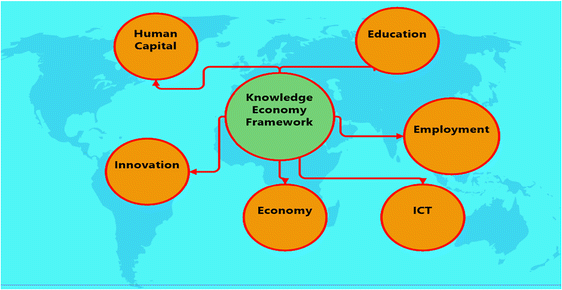
The four pillars of the knowledge economy as stated by Middle East countries are:

Economic Incentive and Institutional Regime.Innovation and technological adoptionIncome from oil transformed the Gulf into distributed societies, oil incomes were so plentiful that the mechanism of taxation was dropped, and the government to focussed singularly on consumption and usage of natural resource wealth. The present-day infrastructure of Gulf states barely existed before the discovery of oil and was built to keep pace with the rising oil incomes, the states’ constructions, beliefs, practices and procedures have all been built around sharing oil money.


This issue has been recognised under the theory of intergenerational knowledge transfer, which holds that the better educated and motivated the parent generation is, the greater will be the supply of knowledge that will be passed on to the future generation. And in that region, only about 25% of the population within the ages of 20 and 65 are currently employed which is the evidence for the lack of intergenerational knowledge transfer.

The third issue that affects motivation to learn and innovate in the Gulf are the policies which allow the import of emigrant labour, with approximately 16 million people currently working. In Saudi Arabia and Oman, these people make up to approximately one-third of the population, whereas in Bahrain about half, and in Kuwait, the UAE and Qatar some 70-80 per cent. This has actually resulted in a major segmentation of the labour market in all GCC countries so that citizens are mainly employed in the public sector and expats in the private sector. A significant effect of this segmentation is that it majorly reduces the struggle for jobs as some citizens need to apply for jobs outside the public sector. In universities, the students expressed a clear inclination for public sector jobs the reasons that come out were the short working hours and attractive benefits, but also due to an articulated dilemma as to whether or not an Emirati student, if he or she wanted to, could successfully compete for jobs in the private sector with well-schooled migrants from India and other parts of the globe. That is, the lack of quality in the education system has snatched the opportunities of the job from the citizens themselves.

The fourth outcome is that ambitious young professionals usually stay in their professional field for a few initial years and then they move to management jobs which actually require very less professional training. This conveys sharp signs to both students and professionals that in-depth professional knowledge or expertise is not valued. Therefore there is no profit in pursuing knowledge, as citizens undertake management functions, expats are brought in to offer professional jobs.

With the aim of developing a Knowledge Economy and its miserable performance on the dimensions of Education and Innovation, this article explained that the region's primary, secondary and tertiary educational systems need to be efficient. It is found that current educational systems in the Gulf do not prepare the students sufficiently, neither to pursue further studies nor engage actively in a Knowledge Economy, this demands skills related to critical thinking, analysis, control of processes and creative and innovative drives.